
Showing posts with label Christine. Show all posts
Showing posts with label Christine. Show all posts
Monday, March 5, 2012

Wednesday, February 15, 2012
Delhi Research Assignment
Company Painting is a particular school of painting which formed during the British rule in India back in the 18th century. It originated as the British East India Company extended its expeditions across South Asia, for which many British employees settled in India. Landing in the foreign and exotic environment, they wished to capture every aspect of the land and its culture, and knew better than to get British painters. Hence, they hired local Indian artists to paint for them in order tomaintain the authentic cultural element in the paintings.“Aesthetically, they are the descendants of the picturesque scenes of India created by the likes of Thomas and William Daniell.”[1]The medium used for these company paintings was water color instead of gouache (a medium similar to water color except heavier and more opaque with the ratio of pigment to water was higher and particles were larger). The paintings reflected the particular region from which they arose. This meaning that the local traditions heavily influenced the styles of the company paintings.
 This company painting depicts six soldiers with their uniforms specific to their posts.
http://upload.wikimedia.org/wikipedia/commons/4/4f/Painting_of_six_figures_depicting_military_uniforms.jpg
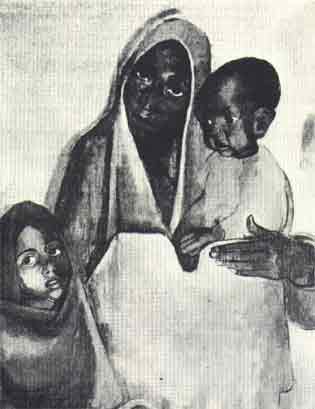
Amrita Sher-Gil was born, in Budapest, in 1913, to Sardar Umrao Singh Shergil (Punjabi) and Marie Antoinette (Hungarian). She grew up in Budapest while the First World War broke out. Due to the dismal events occurring at the time, the Sher-Gils were afraid to head back to India right away. Even after the war ended, their plans to return to India were yet again delayed due to Communist uprisings that occurred in 1919. Growing up, Amrita went back and forth, quite a bit, between Europe and India. Her early childhood paintings were influenced by the Hungarian folklore which her mother used to tell her and her sister, Indira. During her late teens and early twenties, she was sent to Paris, the European capital, for art training. She adapted well into Parisian lifestyle, although she eventually tired of the elite lifestyle. Her art at the time was mostly nude charcoal works. Eventually, she returned to India where her art style took a slight turn, as she began to focus on romanticizing Indian poverty.She then went on to proclaim that her real artistic mission was to “interpret the life of Indians and particularly the poor Indians, pictorially”[2]. However, she is known for the inconsistency in her work. She herself admitted, “My sense of form on the other hand is developing only now and still has a strong tendency to evade me. It very often happens that I grasp it only for a short period and only sections of my painting are good as a consequence.”[3]Some of her many works include Mother India, Three Girls, Self Portrait, and A Hungarian Peasant.

Mother India
Thursday, February 2, 2012


Tuesday, November 29, 2011
Final Resubmission


My concentration is focused on personal memories from various times in my life. Moments are fleeting, and our memories are often the only reminder we have to keep. Although my concentration is called “Black & White Memories”, I always have one element in each piece that has color. The color serves to highlight parts of my subjective memory that stands out. I combine both drawings and photographs in my concentration. This combination helps me to portray memory in all its variations.
Thursday, November 3, 2011


Wednesday, October 5, 2011


Monday, September 19, 2011
Christine L. Lungalang
PART 1 :


Kyung Jeon - detail of "Waterlilies" - water color/pencil Aug. 7 2011
Karen Moss - part 3 of 3 from "Street Life" - collage & acrylic paint on paper (24.5" x 157")
2009
Gale Gibbs - An Irritating Red Bird in the House - c-print (16" x 20") 2011
Jennifer Delilah – Unfamiliar Desire – oil on linen (29” x 21”)
Mark Joshua Epstein - It Was Sad When The Great Ship Went Down - Oil on Canvas (60"x48") 2011
PART 2:
Q1. Exaplin what it is you like about these 5 artworks (elements/common threads)
In general, I like the simplicity in these art works. I like the limited use of color, with the exception of the one by Jennifer Delilah - Unfamiliar Desire. The rest of them relate to my personal style through the less intricate, and simple techniques used by these various artists.
Q2. What is it that these elements are expressing?
These elements all express quite various things. However, the factor that, in a way, ties them together is their simplicity. The first one by Kyung Jeon is very much like my personal style. This is because I like to draw things off the top of my head, but also take images from actual photographs that I take. Also, the second one by Karen Moss, the third by Gale Gibbs, and the fifth one by Mark Joshua Epstein, all are very limited in color. There is only one dominant color throughout each individual artwork. The fourth one by Jennifer Delilah seems to be the most different, but the thing that stands out is the use of patterns and various colors. I like this one quite a lot because of its odd but interesting use of patterns and colors. These all, although some more abstract than others, emits a sense of everyday reality.
Q3. How could you take some of these strategies and apply them to your own work -- either in terms of media, formal quatlities, and/or theme?
I could continue to have the limited-color technique in my following artworks. I could also maintain the simplicity, because that is my personal style. Although my concentration is Black and White Memories, I could try to make my artwork a little bit more abstract and see how that works out.
PART 3: Artist In-Depth
Choose one artist and research what has influenced his or her work. If the artist is alive and has a website you should look at what they've written about their work. If the artist is not
contemporary
Kyung Jeon, a Korean-American artiste, was born in 1975 in Jersey City, New Jersey. She went to various art schools including ones in New York City, NY, and Boston, MA. Her artworks consists of cartoon-ish little characters. In her work, she tries to explore various mediums, including rice paper and vinyl. Jeon's work is influenced by sources such as childrens' fairytales, traditional Korean-genre paintings, and the eccentric worlds of Henry Darger and Heironymus Bosch. She includes the various characters who play out various scenarios in a full spectrum of emotions.
Bibliography:

Sunday, September 4, 2011
Christine: Memory


Here are my first two art pieces. Both of them having to do with various memories of mine. The one on the left, being the memory of prom which I attended in the States last year; and the one on the right being my memory of growing up in Calcutta, as a Naga girl amongst many other Indians - Bengalis.
Monday, August 22, 2011
Nugget 2
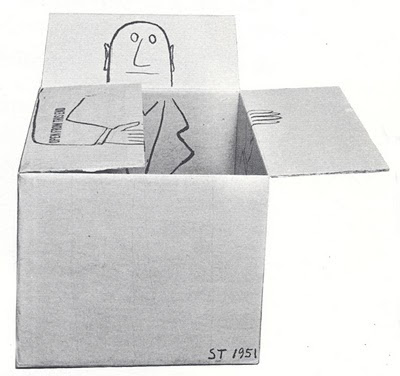


These images are examples of what I want to work with for my body of work. The first two by Saul Steinberg are the drawing-on-photograph style which I really like. The second one, by Alin Ciortea, is a simple black and white picture, which I also am interested in doing something like for my own work.
Tuesday, August 9, 2011
Concentration: Black and White Memories
Word: Treasures
My conentration will be Black and White Memories. This basically means that I will either draw or take black and white picutres of things that bring back memories. I chose this theme surrounding memories because I believe that they are the only things you can keep for yourself as one gets deprived of time before they can come to realize it. Thus, memories help to ponder on and relive those moments that have gone. My pieces might have a hint of color at times, but the main thing I'm trying to focus on is the simplicity but depth of black and white themed art.
My conentration will be Black and White Memories. This basically means that I will either draw or take black and white picutres of things that bring back memories. I chose this theme surrounding memories because I believe that they are the only things you can keep for yourself as one gets deprived of time before they can come to realize it. Thus, memories help to ponder on and relive those moments that have gone. My pieces might have a hint of color at times, but the main thing I'm trying to focus on is the simplicity but depth of black and white themed art.
Friday, August 5, 2011
Saul Steinberg
http://shelleysdavies.com/wp-content/uploads/2011/05/saul-steinberg-chair.jpg
I was JUST introduced to Saul Steinberg's body of work. The image or the idea that really inspired me right away, was his technique of taking a black and white picture of real objects and then drawing perople or things onto them. This concept is a perfect solution for me because I like drawing and I also like black and white photos; and so, this way I can blend both factors of my art style and put them in one piece! :)

I was JUST introduced to Saul Steinberg's body of work. The image or the idea that really inspired me right away, was his technique of taking a black and white picture of real objects and then drawing perople or things onto them. This concept is a perfect solution for me because I like drawing and I also like black and white photos; and so, this way I can blend both factors of my art style and put them in one piece! :)
Andre Kertesz
I enjoy photography and find Kertesz' photographs captivating and intriguing. Firstly, in black and white pictures, the idea, image, and objects captured are more important to this artist than
color and other mediums of art. The simplicity of the photos draws more attention to what he is taking a picture of. This makes his artwork almost errie and mysterious. I feel that the simpler the picture, the more if speaks to its audience.
http://www.youtube.com/watch?v=WI8-vApJHLY
color and other mediums of art. The simplicity of the photos draws more attention to what he is taking a picture of. This makes his artwork almost errie and mysterious. I feel that the simpler the picture, the more if speaks to its audience.
http://www.youtube.com/watch?v=WI8-vApJHLY
Subscribe to:
Posts (Atom)