Showing posts with label Tanya. Show all posts

Thursday, February 16, 2012

Delhi Assignment

Rajput Miniature Art

Rajput Miniature Art traces its roots all the way back to the Mughals. In 1555, Emperor Humayun brought along Persian painters who excelled in this school of painting. This style flourished in India, especially under Akbar, who encouraged Hindu painters to utilize this form and also add more of their own culture into it. Soon, these painters were serving in courts of Rajasthani or Rajput rulers. Characteristics of Rajput Miniature Art include scenes from daily life. Inspired by their Mughal predecessors, they are painted with close attention to detail and in bold colours representing the romantic lives that they depict. Ananda Coomaraswamy, a pioneer of Miniature art divided it into several schools of art, more or less basing it on the areas to which they were popular to. The main schools of miniature art are Mewar, Bundi, Kotah, Marwar, Bikaner, Jaipur, and Kishangarh. Apart from the different origins of these groups, they also have a few distinctions in their content. For example, the school of Mewar had bold lines and burning colours, whereas Bundi was gentler, and more lyrical.

http%3a%2f%2fwww.wiki.indianfolklore.org%2fimages%2f8%2f87%2fRajasthan_miniature.pdf

Francis Newton Souza

Francis Newton Souza was born in the village of Saligao, Goa on April 12th, 1924. He was educated in St. Xavier’s College in Bombay, but was expelled for drawing graffiti in the toilets. However, he claims that he was only improving on a previous drawing, just because he thought it was very ugly. Later, he attended the Sir J.J School of Art, one of India’s most prestigious art schools, but expelled in 1945 due to his support of the Quit India Movement. Souza’s style of work has been defined as expressionistic. He has had wide recognition in the West. The Times of India describes it as this: "Be it the sluts or the suits, the seamy side of life or the steamy, the gnomish, pox-scarred boy from Goa who went on to become one of the first Indian artists to be feted in the salons of Europe, laid it bare."
A strong Catholic, many of Souza’s paintings focus on scenes from the Bible. His other inspirations include a strong sense of patriotism. Though Souza eventually moved to London, and then to New York soon after, he visited his home country every winter. He enjoys the use of bold colours and also erotic scenes, which he says were both inspired by the Indian culture. He also founded the Bombay Progressive Artist’s Group, which is still active today in producing avant-garde works of art.

http://www.fnsouza.com%2f
http://.contemporaryindianart.com%2ffrancis_newton_souza.htm

Monday, November 28, 2011

Concentration Repost

THE GIRL WITH THE PEARL EARRING

SALVADOR DALI AND CLOTHES
CROWS ZERO
THE KING'S SPEECH

THE RED BALLOON
THE GRADUATE

a·nach·ro·nism : The representation of someone as existing or something as happening in other than chronological, proper, or historical order. For my concentration theme, I chose anachronism, which simply defined, means something that is out of the time. For me, art should be timeless, therefore by juxtaposing objects and situations from another time to a contrasting one, I think I can achieve a body of work that is humourous, bold and innovative. I plan to experiment with colors, art styles and art subjects with a central theme that combines the past and the present, the old and the new.

Monday, September 19, 2011

Nugget


Sung Jin arrives in London 1 145.5x179 cm Inkjet on Canvas 2009

Sailor Moon 36x48 inches Acrylic on Canvas 2004
Almost Too Far Gone 122x183 cm Oil on Linen 2010

Amanda 18x36 inches Silkscreen 2000

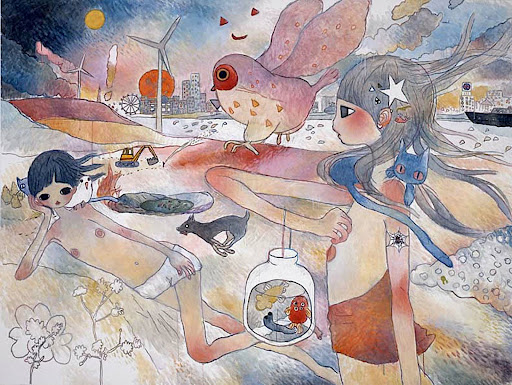
Summoning her owls, she looked yonder. The buildings shone.194x259 cm Acrylic on Canvas 2007


1. Explain what it is you like about these 5 artworks (elements/common threads)


These artworks share many common elements. Firstly, they all employ a bold use of color. Some artists like Katz and Mosquera use more vivid and sold colors, while Shimomura, Opie and Takano keep it more pastel and use earthy tones. I also like the slightly cartoonish aspect of it as well. All of these artworks depict a real person, but painted like an illustration. This also goes well with my theme since I am trying to capture movie scenes with real people into a cartoonish piece.

2. What is it that these elements are expressing?

All of these pieces lie on a bridge between realism and cartoon. In some ways, what they are implying are also on that bridge. For instance, in Laura Mosquera's piece, the main subject, the girl, looks tired. She feels a bit wacky. The background behind the girl are comic-like stripes. But in the middle the same lines start doing something wacky, demonstrating the girl's, perhaps, mundane life. The same with Aya Takano's artwork. They are almost like doodles of an outer world, but they represent a very realistic issue in the world.


3. How could you take some of these strategies and apply them to your own work -- either in terms of media, formal qualities, and/or theme?

I would certainly like to incorporate some of the color schemes into my artwork. Also, the juxtaposition of some of the main subjects are very cleverly done. The other thing that I would like to add is some of the simplistic drawing styles that these artists work with. Also, many of them use acrylic paint so I would certainly like to experiment with that medium.

PART 3


1. Choose one artist and research what has influenced his or her work. If the artist is alive and has a website you should look at what they've written about their work. If the artist is not contemporary, then research what others have written about this artist.

I chose to research Julian Opie. Opie wanted to make art that could be displayed on billboards. He is "determined to bring his work to the people". He was not always enthusiastic about art though. "People said I should go to art school," he says, "which I thought was for losers." He did attend art school. He likes his art to be "very passive and very easy, which is something that appeals to me."


URL for pictures
http://www.gregkucera.com/shimomura/yellow_terror/content/Roger_Shimomura_paintings_8_large.


http://lh5.ggpht.com/-9-b6DvzhfMk//1047212111bd01.jpg

http://www.perrotin.com/fiche.php?id_pop=12111&&idart=15&&dossier=Aya_Takano&&num=36&&p=3

Sunday, September 4, 2011

Anachronism in Movies


THE GRADUATE
This artwork is based on the movie, The Graduate, starring Dustin Hoffman. This is
one of my favorite movies and this is the most famous scene from it.


THE RED BALLOON
This artwork is from Albert Lamorisse' classic short film, The Red Balloon. This is the opening scene of the movie.

THE KING'S SPEECH
This artwork is based on the King's Speech as well as on artist, Julian Opie's style.


CROWS ZERO
This artwork is based on the characters of Crows Zero, with acrylic paint and watercolour for the faces.


Monday, August 22, 2011

Takeshi Obata, Manga artist

Takeshi Obata is a manga artist. He has gained recognition via his popular manga Death Note. These are some of his other art pieces.

Wednesday, August 10, 2011

Glenn Brown, UK


Glenn Brown, UK
I like this artist because he combines classical art with something modern. He was sharp colors and a tinge of one contrasting color and uses swirls and lines to promote value. He also creates surrealistic paintings, inspired by works of Salvador Dali and adds something new and hip to it.

http://www.gagosian.com/artists/glenn-brown/

Tuesday, August 9, 2011

Concentration Theme: Anachronism

a·nach·ro·nism : The representation of someone as existing or something as happening in other than chronological, proper, or historical order.

For my concentration theme, I chose anachronism, which simply defined, means something that is out of the time. For me, art should be timeless, therefore by juxtaposing objects and situations from another time to a contrasting one, I think I can achieve a body of work that is humourous, bold and innovative. I plan to experiment with colors, art styles and art subjects with a central theme that combines the past and the present, the old and the new.