
Showing posts with label Luniva. Show all posts
Showing posts with label Luniva. Show all posts
Monday, March 19, 2012

Wednesday, February 15, 2012
Contextual Research Assignment
BENGAL SCHOOL OF ART
The Bengal School of Art was a movement of art that thrived in India in the early 20th century. The style of art associated with Indian Nationalism during the time when the nation was still a British Colony – it was a revitalization of Indian culture, history and spirituality. The Bengal School triggered an innovative surge to react against the western academic art styles that were previously promoted by both the Indian and British art schools. The themes that revolved around this form of art involved romantic and misty representations of the Indian terrain, historical sites as well as the depiction of the life in the countryside. Embracing the more traditional methods of creating art (using indigenous techniques as well as media) was difficult for the artists of the time who were more accustomed to western methods and inspirations. This nationalist movement was initiated by Abanindranath Tagore as well as British art teacher Ernest Binfeil Havell who tried to change the teaching methods at the Calcutta School of Art by encouraging students to adopt the Mughal style of art, the students however found this attempted reform degenerating.
 |
| Abanindranath Tagore, The Passing of Shah Jahan, oil on board, 1902. |
The Modernist ideas that began to form in the 1920’s caused the Bengal School’s influence on creating traditional art to decline severely.
JAMINI ROY lived from the April of 1887 to the April of 1972. Though he was brought up in a middle-class family of land-owners in the village of Beliatore in Bengal, he spent the majority of his life in Calcutta where he had moved to at the age of 16 to study in the Government School of Art (GSA). There he learnt to paint in the then dominant style of western art that consisted of drawing Classical nudes and using oil paints. He received his diploma in Fine Arts in 1908 but soon discovered that he had a perpetual fervor for creating art that was inspired by his own ethnic Indian culture rather than the western cultures he had studied in GSA. Roy began to focus on Kalighat Pat (folk and tribal art) and soon after became enthralled in his fascination in the Santhal (traditional) dance. He adopted this new style as a reaction against the Bengal School and the Western cultures that dominated Indian Art and deprived it of making its mark in the international world of art. Roy wanted to depict the look of simplicity of the folk people as well as make art accessible to people from diverse backgrounds. He was once quoted:
"I am least bothered whether my paintings is good or bad, and I feel that it is no concern of mine. My sole desire is to make my paintings look different."
Roy liked using the cheap indeginous pigments for his artworks which was not something many contemporary artists had experimented with at that point in time.
 |
| Dancing Gopi (Maiden), Jamini Roy , Gouache on paper. |
Thursday, February 9, 2012
Holiday (Re) Submission

Stencil Self-portrait - Acrylic
 |
| Self-Portrait - Pencil |
Tuesday, December 6, 2011
Final Concentration Pieces
 |
| Shot Pen on Cartridge Paper |
 |
| Couldn't Save a Fish Acrylic Base and Oil on Canvas |
 |
| And it Rained Acrylic on Canvas |
 |
| Automobile and Buddha Acrylic and Pen on Canvas |
 |
| Stop Acrylic and Pen on Canvas |
 |
| Smothering Smog Acrylic Base and oil on Canvas |
 |
| Blue Bliss Watercolour on White Cartridge Paper |
 |
| The God in Me Greets the God in You Acrylic and Charcoal on White Cartridge Paper |
• My concentration focuses on the diverse potential outcomes of Buddhism. With my pieces I explore the various ways in which this religion would shape itself in the obscure future. Would Buddhists adapt to the drastic situations of the world or would they be driven to the edges to survive even in the most severe settings? When modern technology intensifies to an entirely new level and when culture and religion no longer rule the lives of the people what would the world look like? The aim of my concentration would be to focus on how my religion, Buddhism, would transform or adapt in the technologically dominated future.
Thursday, December 1, 2011
Final Submission
|
| Smothering Smog Acrylic Base and oil on Canvas |
|
| Blue Bliss Watercolour on White Cartridge Paper |
 |
| Couldn't Save a Fish Acrylic Base and Oil on Canvas |
 |
| Automobile and Buddha Acrylic on Canvas |
 |
| Stop Acrylic on Canvas |
|
| The God in Me Greets the God in You Acrylic and Charcoal on White Cartridge Paper |
• My concentration focuses on the diverse potential outcomes of Buddhism. With my pieces I explore the various ways in which this religion would shape itself in the obscure future. Would Buddhists adapt to the drastic situations of the world or would they be driven to the edges to survive even in the most severe settings? When modern technology intensifies to an entirely new level and when culture and religion no longer rule the lives of the people what would the world look like? The aim of my concentration would be to focus on how my religion, Buddhism, would transform or adapt in the technologically dominated future.
Monday, November 28, 2011
6 Concentration Pieces
|
| Smothering Smog Acrylic Base and oil on Canvas |
|
| Blue Bliss Watercolour on White Cartridge Paper |
|
| Couldn't Save a Fish Acrylic Base and Oil on Canvas |
|
| Automobile and Buddha Acrylic on Canvas |
|
| Stop Acrylic on Canvas |
|
| The God in Me Greets the God in You Acrylic and Charcoal on White Cartridge Paper |
• My concentration focuses on the diverse potential outcomes of Buddhism. With my pieces I explore the various ways in which this religion would shape itself in the obscure future. Would Buddhists adapt to the drastic situations of the world or would they be driven to the edges to survive even in the most severe settings? When modern technology intensifies to an entirely new level and when culture and religion no longer rule the lives of the people what would the world look like? The aim of my concentration would be to focus on how my religion, Buddhism, would transform or adapt in the technologically dominated future.
Thursday, November 3, 2011
Luniva: November Concentration
 |
| 'Couldn't Save a Fish' Acrylic Base and Oil on Canvas |
 |
| 'STOP' Mixed Media on Canvas |
Wednesday, October 5, 2011
Luniva: The Future II
The future remains obscure.
My two pieces are poles apart. Whilst one shows a tranquil blue environment the other illustrates a deranged and polluted dirty brown city. A monk meditates in a reserved area where nothing can be seen from miles and miles, and then in an entirely new setting, another monk walks away from a congested city that is polluted to such an extent that the monk is forced to wear a gas mask. ‘Smothering smog’ and ‘Blue Bliss’ are two derivations from my explorations on the future.
My two pieces are poles apart. Whilst one shows a tranquil blue environment the other illustrates a deranged and polluted dirty brown city. A monk meditates in a reserved area where nothing can be seen from miles and miles, and then in an entirely new setting, another monk walks away from a congested city that is polluted to such an extent that the monk is forced to wear a gas mask. ‘Smothering smog’ and ‘Blue Bliss’ are two derivations from my explorations on the future.
 |
| "Smothering Smog" Acrylic Base and Oil on Canvas |
 |
| "Blue Bliss" Watercolour on White Cartridge Paper |
Monday, September 19, 2011
Luniva Shakya
Part 1: Top 5
 |
Jason D. Watson, Blindspot, graphite colored pencil, acrylic wash, gouache on paper, 2009, 50 " x 38 " |
 |
Cecy Colichon, Visions STLS IV,Oil Painting, 2005 |
 | ||
|
 |
Karla Knight, The Farmer, Oil on Wood, 1985, 18” x 19” |
 |
Daniel Hill, Untitled #13, acrylic polymer emulsion on paper mounted on canvas, 2009, 40” x 50” |
Part 2: Synthesize
1. Explain what it is you like about these 5 artworks (elements/common threads).
In these pieces there is a definite sense of human as well as otherworldly realities that are portrayed either by creating illusions (‘Untitled #13’ – Daniel H ill & ‘The Farmer’ – Karla Night) or by juxtaposing various possible scenes with bizarre or unrealistic ideas (‘Pull’ – Yeshe Parks & ‘Blindspot’ - Jason D. Watson). The complexity and diversity incorporated in each of each of them portray some sort of intangible world that is mesmerizing. They have certain elements that make the piece stand out: things like bold empowering colors, use of space and lines, as well as tone are some of the certain aspects that I find remarkable in these artworks.
2. What is it that these elements are expressing?
There is a surreal element to each of the images that display different things in different ways. The geometrical lines and use of space creates this aura of absurdity that is peculiar but still appealing to the eye – it makes one think of the complexities of mathematics! There is originality in the way the artists have included the random objects in such a way – it makes viewers look at the artwork at different levels so to understand the piece. There is a sense of experimentation, a sense of how the creator has incorporated complicated visions and dreams of their own onto canvas. Though they are all quite different from each other I feel that there is definitely a surrealistic idea behind each of them. They all express the message of obscurity and ambiguity.
There is a surreal element to each of the images that display different things in different ways. The geometrical lines and use of space creates this aura of absurdity that is peculiar but still appealing to the eye – it makes one think of the complexities of mathematics! There is originality in the way the artists have included the random objects in such a way – it makes viewers look at the artwork at different levels so to understand the piece. There is a sense of experimentation, a sense of how the creator has incorporated complicated visions and dreams of their own onto canvas. Though they are all quite different from each other I feel that there is definitely a surrealistic idea behind each of them. They all express the message of obscurity and ambiguity.
3. How could you take some of these strategies and apply them to your own work -- either in terms of media, formal qualities, and/or theme?
Their surreal ideas as well as their boldness to create something unheard/unseen of is something that has motivated me to continue being more creative with my pieces for my concentration. I love how the pieces have this extraterrestrial feel that is mysterious but capturing at the same time. Though they are different in their use of medium, I hope to show more correspondence between my works. I now encourage myself to practice my art and possibly focus using only a few mediums (ie. acrylic, oil paint and charcoal). I will also now be aware of how I use the canvas space as well as lines and regular shapes to create a more ‘futuristic’ look that will captivate my viewers. I also hope to adopt the theme of juxtaposing realities and dreams to portray what my visions of the future will be.
Part 3: Artist In-Depth
3. Choose one artist and research what has influenced his or her work. If the artist is alive and has a website you should look at what they've written about their work. If the artist is not contemporary, then research what others have written about this artist.
Cecy Colichon’s work, as she says so herself, comprises of “an aspect or puzzle piece to a larger concept” – I really like this outlook on her basis of work. Her early works consisted of “geometrical, planar and mechanical forms that express 2D and 3D volume relationships that appear to move in two directions at the same time” – her style is very surreal and I never fail to become captivated by it. Her visual effects give this feel of mathematical order that is superbly represented. Her interest lies in the fields of Theoretical Physics, Biology and Theology – she has the desire to express spiritual elements as well that she was inspired by from her native Peruvian heredity. I too hope to incorporate the religious and cultural aspects of my life in my artwork.
To end, I would like to include a quote I really liked from her:
“Although the scientific method in the strictest sense involves the testing of finite ideas with measurable parameters, I believe that the creative process towards discovery in science also involves a degree of intuition. Intuition is an essential element ...”
Sunday, September 4, 2011
Luniva: The Future
What stance will my religion have in the future? When modern technology advances to a whole new level - an unforeseen future where culture and religion may no longer rule the lives of people who have become obscure to the morals their ancestors were brought up in?
My two pieces are somewhat contradictory to each other. My first is composed of a robot/machine hand and a human hand pressed together forming a "Namaste".
My two pieces are somewhat contradictory to each other. My first is composed of a robot/machine hand and a human hand pressed together forming a "Namaste".
"Namaste" is a general way of greeting one another in Nepal (as well as India) - it is a sign of respect. But in a more Buddhist perspective it can mean '"The God in me greets the God in you".
 |
| "The God in me greets the God in you" Acrylic and Charcoal on White Cartridge Paper |
My second piece is one that juxtaposes two different ideas: to devote, and to disrespect.
I was inspired by Banksy's stencil work as well as by the aircraft graffiti that was prominent in Wars.
In a way the stencil of Lord Buddha shows that the driver of the futuristic automobile is 'devoted' to buddism, but in another perspective, it is somewhat disrespectful to have his face graffiti-ed on a form of transportation.
The cloud forms the Buddhist sign "endless knot" which signifies the wisdom of Buddha - one which has no beginning nor an end (it has many other interpretations).
 |
| Inspired by Dragonflies: Automobile and Buddha Acrylic on Canvas |
Monday, August 22, 2011
Nugget #2
 |
| Heaven Falls |
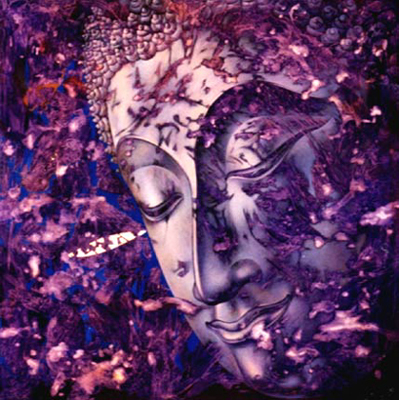
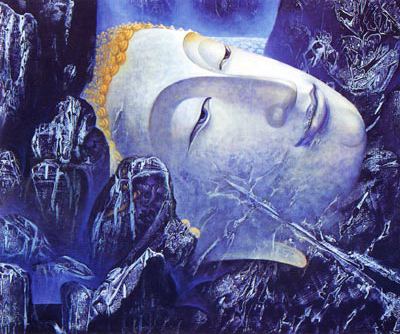
Panya Vijinthanasarn ('Heaven Falls' & 'Mind of The Forest') &
Odilon Redon ('Buddha in His Youth' & 'The Buddha') are the two artists I have chosen. Their techniques and styles make me mesmerized and fit with the my theme of 'Buddhism in the Future'. I really like their use of color as well as their portrayal of Buddha. I hope to incorporate the same on my concentrations.
 |
| Mind of The Forest |
 |
| Buddha In His Youth |
 |
| The Buddha |
Tuesday, August 9, 2011
Tomorrow
My Word: Tomorrow
The ambiguous future is in itself a vast and complex topic. The aim of my concentration would be to focus on how my religion, Buddhism, will transform or adapt in the technologically dominated future. I hope to combine futuristic aspects of what I feel the ‘new-fashioned’ world will look like and engrave within it a distinguished religious context of gaining enlightenment. I hope to juxtapose a meditative and tranquil atmosphere with the hectic ‘modern-ified’ future. What triggered me to choose this topic is the desire to know how my religion will transform/persist in the future. I wish to apply Buddha’s teachings/dharma of maintaining integrity and living in an impartial manner to portray how ‘tomorrow’ when the world is materialistic and when consumerism is at its peak they would only need one thing to regain contentment: Religion.
Sunday, August 7, 2011
Bridget Riley
I cannot put into words how much of an inspiration Bridget Riley and her ‘Op Art’ movement has been to me. Her captivating work consists of the most simplistic elements and is yet transformed and molded in such a way that, to the viewer, it is beyond complex. Her enchanting black and white body of artworks creates optical illusions that fascinate me, makes me realize it doesn’t take much for an artist to make an impact to her viewers; all she needs is her willingness to portray her aesthetic visions on canvas without fear of being criticised…
Of her artworks Riley said “‘the eye can travel over the surface in a way parallel to the way it moves over nature. It should feel caressed and soothed, experience frictions and ruptures, glide and drift…One moment there will be nothing to look at and the next second the canvas seems to refill, to be crowded with visual events.”
 |
| Bridget Riley 1961 Movement in Squares Tempera on Board 122 x 122 cm |
 |
| Bridget Riley 1961 Britannia Emuslion on cardboard 56 x 61 cm |
 |
Bridget Riley 1966 Untitled: Diagonal Curve Emulsion on Board 130 x 130 cm |
Subscribe to:
Posts (Atom)